> ## Documentation Index
> Fetch the complete documentation index at: https://docs.stratapt.com/llms.txt
> Use this file to discover all available pages before exploring further.
# Get From Previous Docs
> How to use Get From Previous Docs to pull specific sections from a prior clinical document into the document you're currently working on.
**Get From Previous Docs** lets you pull specific sections of content from a specific prior clinical document into the document you're currently working on. Unlike the inheritance options you choose when starting a document, Get From Previous Docs works section by section, from inside the document itself, so you can cherry-pick exactly which content comes from which prior note.
**Access:** Available to all clinicians creating clinical documentation. There is no separate permission required to use Get From Previous Docs.
***
## How Get From Previous Docs Works
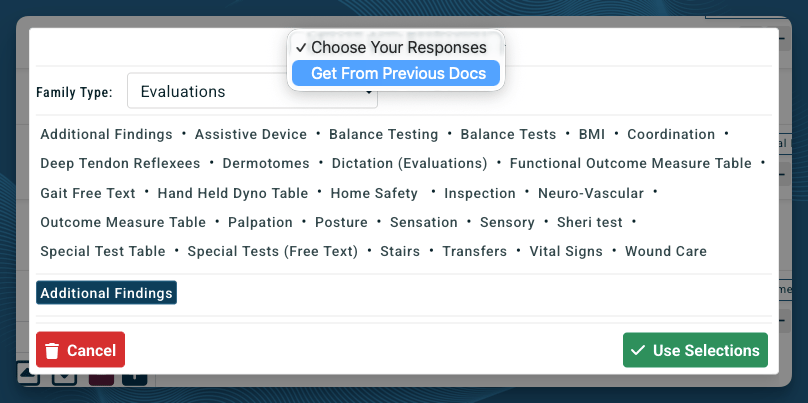 Click any section heading within a document to open the fragment selection box. At the top, you'll see a **Choose Your Responses** heading - click it and change the selection to **Get From Previous Docs**.
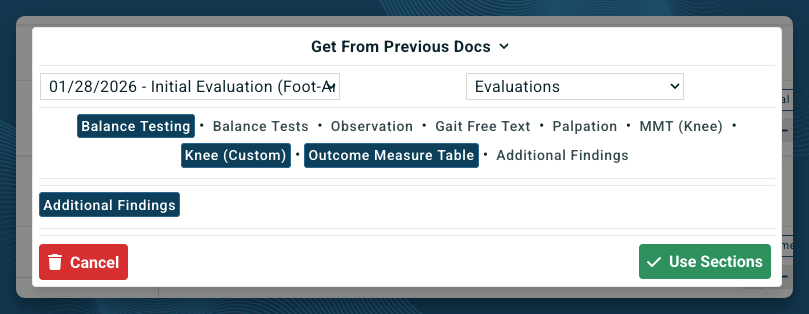
This opens a new box with two drop down boxes:
* **Left drop down** - select the clinical document you want to pull from.
* **Right drop down** - select the specific section(s) within that document you want to bring forward.
Click to highlight the sections you want, then click **Use Sections**. StrataEMR pulls that fragment including any information that was recorded in it, into the current section of your document.
You do this one heading at a time. Each heading can pull from a different prior document if needed, so you're not limited to inheriting an entire document's worth of content from a single source.
Click any section heading within a document to open the fragment selection box. At the top, you'll see a **Choose Your Responses** heading - click it and change the selection to **Get From Previous Docs**.
This opens a new box with two drop down boxes:
* **Left drop down** - select the clinical document you want to pull from.
* **Right drop down** - select the specific section(s) within that document you want to bring forward.
Click to highlight the sections you want, then click **Use Sections**. StrataEMR pulls that fragment including any information that was recorded in it, into the current section of your document.
You do this one heading at a time. Each heading can pull from a different prior document if needed, so you're not limited to inheriting an entire document's worth of content from a single source.
 ***
## Get From Previous Docs vs. Starting-Document Inheritance Options
When you start a new document, you choose one of three options, **Inherit Previous**, **Inherit Patient Intake**, or **Start From Blank**, and that choice applies automatically to the whole document, pulling from the patient's most recently completed document. See [Starting Documentation](/documentation/clinical-documentation/starting-documentation) for details on those options.
**Get From Previous Docs** is different: it's used from inside a document you've already started, applies one section at a time, and lets you choose any prior document as the source, not just the most recent one.
A common pattern is to start a document from a blank template, then use **Get From Previous Docs** on individual headings to pull in only the specific content you need.
***
## Using Get From Previous Docs During a Re-Evaluation
Get From Previous Docs is especially useful for Re-Evaluations, where you want to compare a patient's current status against specific prior scores rather than pull an entire document forward.
For example, starting a Physical Therapy Re-Evaluation from a blank template:
1. Click the **Evaluations** heading.
2. Change **Choose Your Responses** to **Get From Previous Docs**.
3. On the left, select the prior document, for example, the patient's Initial Evaluation.
4. On the right, select the specific sections you want, for example, balance, knee, and outcome measure scores.
5. Click **Use Sections**.
The prior scores for those sections carry into your Re-Evaluation, giving you a baseline to reference while you re-administer the same assessments and record the patient's current scores, making it easy to see change over time.
***
## Get From Previous Docs vs. Starting-Document Inheritance Options
When you start a new document, you choose one of three options, **Inherit Previous**, **Inherit Patient Intake**, or **Start From Blank**, and that choice applies automatically to the whole document, pulling from the patient's most recently completed document. See [Starting Documentation](/documentation/clinical-documentation/starting-documentation) for details on those options.
**Get From Previous Docs** is different: it's used from inside a document you've already started, applies one section at a time, and lets you choose any prior document as the source, not just the most recent one.
A common pattern is to start a document from a blank template, then use **Get From Previous Docs** on individual headings to pull in only the specific content you need.
***
## Using Get From Previous Docs During a Re-Evaluation
Get From Previous Docs is especially useful for Re-Evaluations, where you want to compare a patient's current status against specific prior scores rather than pull an entire document forward.
For example, starting a Physical Therapy Re-Evaluation from a blank template:
1. Click the **Evaluations** heading.
2. Change **Choose Your Responses** to **Get From Previous Docs**.
3. On the left, select the prior document, for example, the patient's Initial Evaluation.
4. On the right, select the specific sections you want, for example, balance, knee, and outcome measure scores.
5. Click **Use Sections**.
The prior scores for those sections carry into your Re-Evaluation, giving you a baseline to reference while you re-administer the same assessments and record the patient's current scores, making it easy to see change over time.