

Access: All staff can view a patient’s case and the Policies page within a patient’s case.
How the Payment Screen Works
Recording a payment creates an accurate financial record for the visit and starts the payment application process (see How Unapplied Funds Work). StrataEMR always tries to apply a payment right away — first to a balance on the date of service you select, and if none exists yet, to the oldest outstanding balance on the account. A payment collected before its claim has adjudicated will often apply to an older balance in the meantime, then shift back to its intended date of service once that claim resolves and needs the funds. This is expected behavior — it keeps money from sitting unused while a specific claim is still pending. A payment made against a balance that’s already been billed — meaning the claim has already adjudicated and StrataPT has mailed the patient a statement — applies directly to that outstanding balance, since there’s nothing to wait on.Where You’ll See Payment Is Due
On the Schedule
When you open a visit on the schedule by clicking the pencil icon, you’ll see two amounts:- Collect — what to collect for today’s visit (the copay or coinsurance)
- Balance — the patient’s total outstanding account balance across all dates of service
On the Patient’s Case
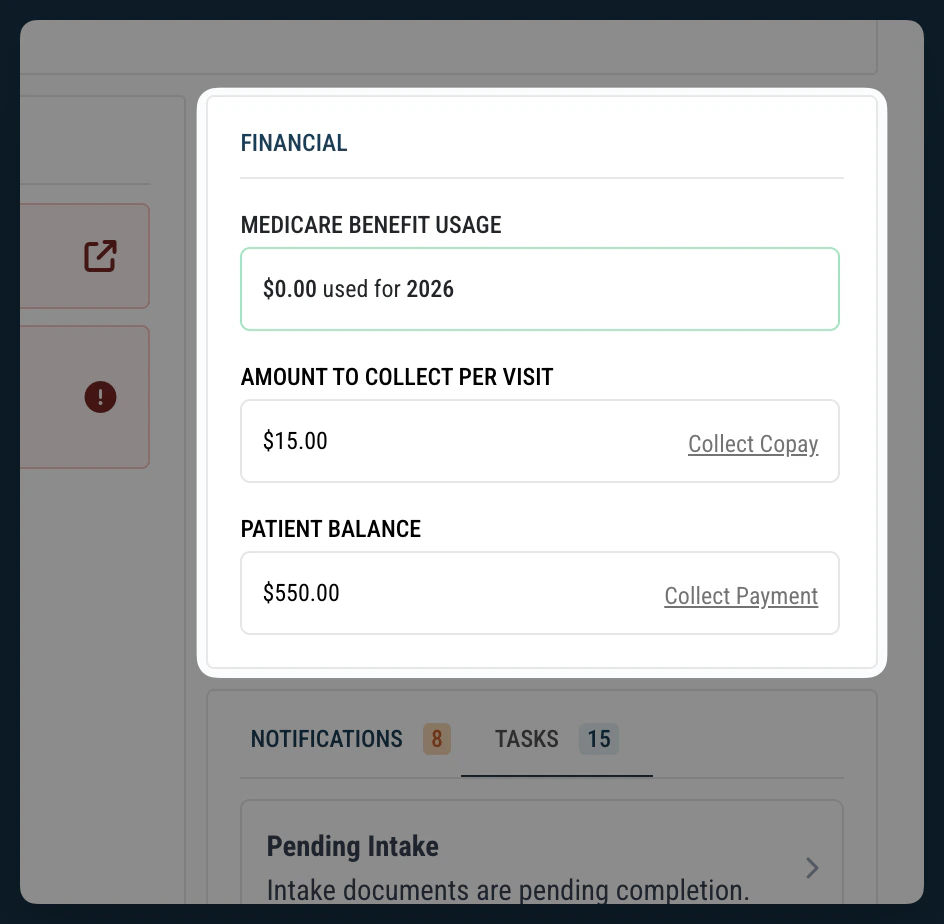
When you’re inside a patient’s case, the Financial card in the right sidebar shows the same two figures:- Amount to Collect Per Visit with a Collect Copay link
- Patient Balance with a Collect Payment link
From the Financial Menu
From anywhere inside a patient’s case, hovering over Financial in the patient menu bar and clicking Payments takes you to the same payment screen as the sidebar links.Payment Fields
Payment Date / Service Date: The date the payment was collected and the date of service it should apply to. StrataEMR prioritizes the service date you enter; if no matching service date is found, the payment applies to the oldest outstanding balance. Amount: The dollar amount collected. Type: (manual payments only) Cash, Check, Credit Card (for cards run on a separate terminal), or Other. Selecting Other requires a description in the Notes field. Related to Invoice: Set to Yes only when the payment is made in response to a statement StrataPT mailed to the patient. Because statements go out only after a claim has fully adjudicated, this in practice means the balance being paid is already adjudicated, so the payment applies directly to it. Set to No for time-of-service collections made before the claim has adjudicated; StrataEMR applies the payment to the best available balance right away and re-applies it to this date of service automatically once the claim adjudicates, if it’s still needed there.Note that if a patient’s balance consists entirely of Point of Sale charges, StrataPT will not mail a statement for it.
Payment History
The Payment History section at the bottom of the payment screen shows every payment recorded for the patient — date, amount, service date, payment type, notes, and whether it was related to an invoice. Payment records can be edited or deleted here if a correction is needed.Authorize.net and Online Payment Timing
If your practice uses Authorize.net for credit card processing, payments collected through the patient portal are batched on a schedule set by Authorize.net — typically within 1–2 business days. The payment appears in StrataEMR immediately after it’s recorded, but the deposit to your bank account follows Authorize.net’s settlement schedule. If expected deposits aren’t showing up, confirm the payment processed successfully in StrataEMR before contacting Authorize.net support.Related
- Collect a Patient Payment — Step-by-step instructions for recording a payment through Authorize.net or manually.
- How the Recommended Collection Amount Works — How StrataEMR estimates the copay and coinsurance amounts shown at check-in.
- Copay, Coinsurance, and Deductible — What each type of patient responsibility means and how it’s calculated.